 CYBRAN
Transfers
Private transfers
Send on Robinhood Chain without publicly linking your address to the receiver's.
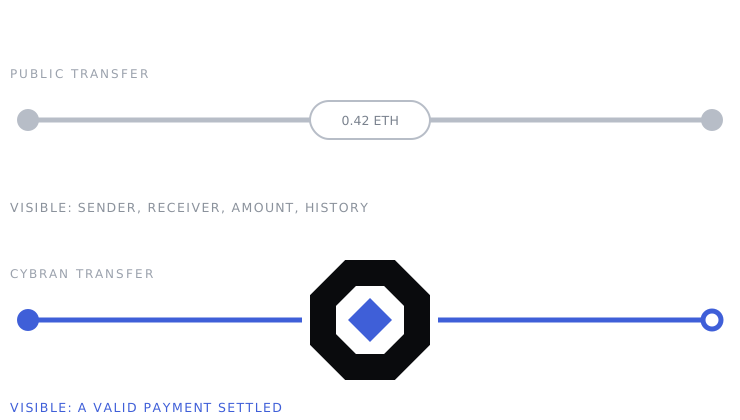
Every transfer on a public chain publishes who paid whom, for how much, forever. Cybran settles the payment on the same chain and leaves that link off the book.
An address is a permanent record. Salary, rent, a payment to a friend, the size of your position: anyone with the address can read all of it, and keep reading it forever.
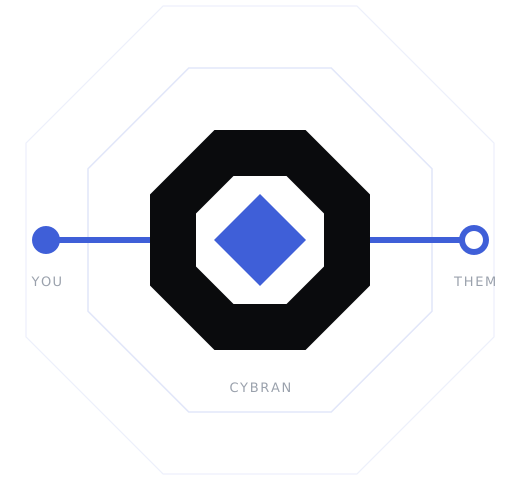
Cybran does not hide the chain. Settlement stays public and verifiable. What it removes is the line between the sender and the receiver, so a payment proves it is valid without naming the people on either end.
Your keys never leave your wallet, and no Cybran contract can move funds you have not authorised.
One click from a Robinhood Chain wallet. Cybran reads your address and balance and nothing else. There is no account, no signup and no email.
Your deposit is public, like any transaction. It joins every other deposit of the same size, and from that moment your funds are one of many rather than one of yours.
Withdrawing to the receiver carries a zero-knowledge proof: it shows the payment is backed by a real deposit without revealing which one. The chain verifies the maths, not your identity.
Send on Robinhood Chain without publicly linking your address to the receiver's.
Pay many recipients in one flow. Useful for payroll, contributor rounds and airdrops.
Share a link that collects a payment for you, instead of pasting your main address into a public chat.
Works with the Robinhood Chain wallets you already use. Nothing is custodied, ever.
Each of these extends the same infrastructure rather than replacing it.
The same privacy for supported tokens and stablecoins on Robinhood Chain.
Scan and pay, for peer to peer and real world settlement.
Subscriptions, payroll and scheduled transfers that stay private each cycle.
A fresh one-time receiving address per payment, so incoming funds cannot be stacked against one public identity.
Drop private payments into any wallet or dApp on Robinhood Chain with a few lines of code.
Cybran charges a 0.2% protocol fee on payments made through its infrastructure. 100% of that revenue is used to buy $CYBR on the market and burn it. No treasury cut, no discretionary spend, one rule.
No. Every action is a transaction your own wallet signs and submits. Cybran has no custody, no admin key over user balances and no ability to freeze an address.
Yes. Settlement happens on Robinhood Chain and anyone can verify that a payment was valid. What the chain does not record is which sender belongs to which receiver.
The size of the anonymity set. The more deposits sit in the pool, the harder any single payment is to attribute. Withdrawing straight back to the address you deposited from undoes it, so the app warns you when you try.
Network gas, plus a 0.2% protocol fee on payments routed through Cybran. The fee goes entirely to buying and burning $CYBR.
The payment tools in the app run entirely in your browser against your wallet and are open to inspect. The shielded pool contracts go live after an external audit, and the report will be published here.